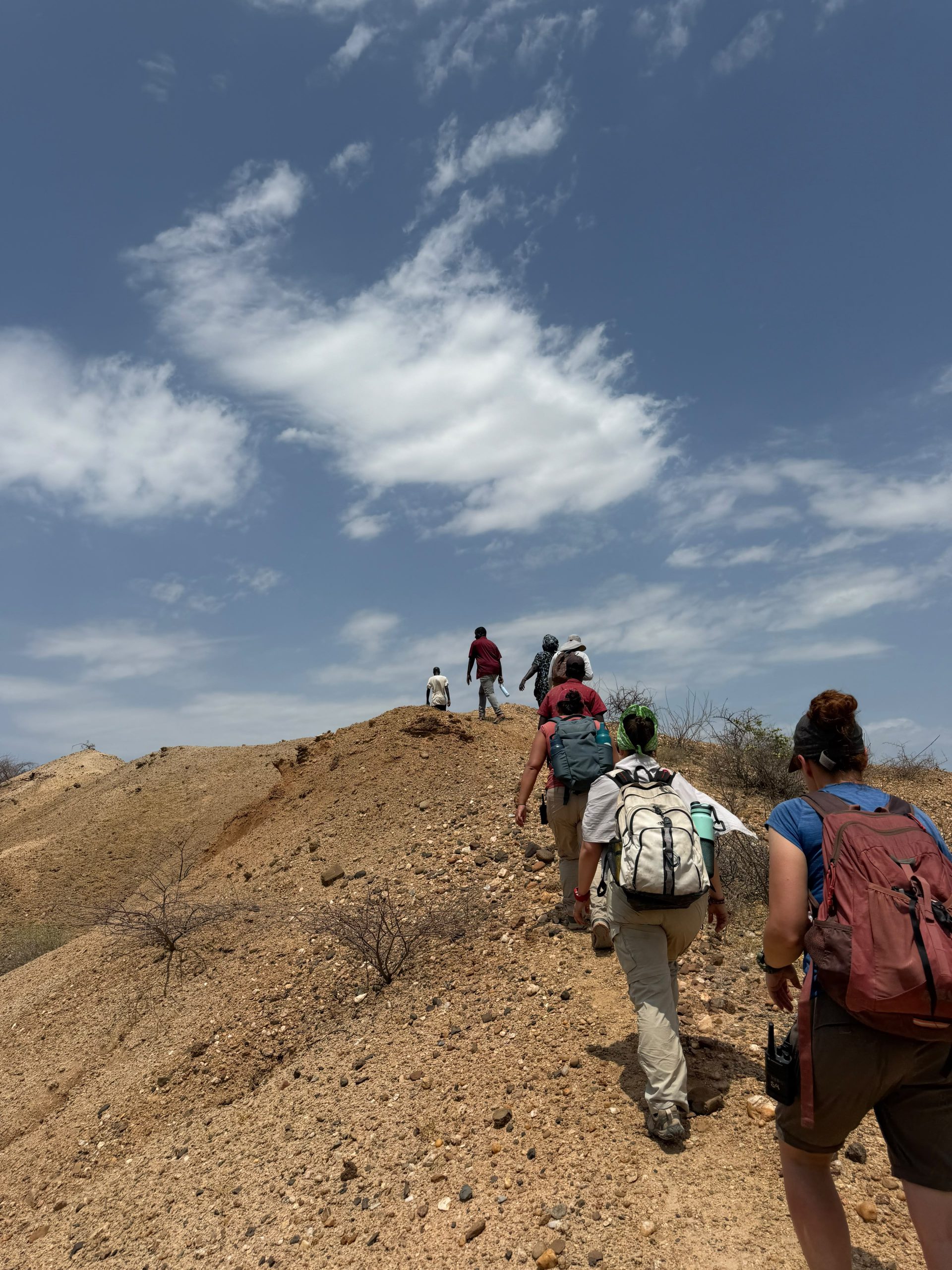
In June of 2026, I had the opportunity to return to the Koobi Fora Field School through George Washington University. This year I joined the field school as an intern and peer mentor and learned more about how to keep the camp functioning.
Final Project Outcome
This research poster was presented at SUNY Oneonta’s Summer Research Showcase as an output from a Tyler Fellow’s Center for Global Education project that was funded in the Summer of 2026.
What I did
Within the East Turkana region of Northern Kenya, we used fossil data to explore how ancient ecosystems shaped early human behavior. We asked how the structure of past bovid communities may have influenced hominin access to meat—whether through hunting or scavenging. Bovids (the group that includes antelope, buffalo, and other large herbivores) are among the most common fossils found at Plio-Pleistocene sites, and their ecological traits provide insight into the environments hominins encountered. We identified fossil bovid teeth and used published data on modern African bovids to assign each tribe a set of ecological traits, including diet, habitat preference, locomotion, social behavior, body size, and water dependence. These metrics describe how many different ecological roles are represented in a community, how evenly those roles are distributed, and how similar the taxa are to one another in terms of how they use the landscape.The goal was to evaluate whether some communities offered more consistent or predictable prey opportunities than others. Although functional trait analysis is widely used in modern ecology and increasingly applied to paleoecology to reconstruct environments, this project is the first to use these methods to address questions about early hominin carnivory.
What I learned
This work builds upon the foundation that I have been building over the last couple of years and allowed me the opportunity to experience the Koobi Fora Field School in a new position. My new role included assisting students with their R-code and GIS mapping, as well as guiding literature review sessions, teaching small lectures, and editing and grading their final outcome papers and PowerPoint presentations. I was able to help on multiple projects and continue to expand my breadth of experience with research and to integrate a mentorship position as well.
What’s next for me
I am currently a senior at SUNY Oneonta currently pursuing a double major in Biology and Anthropology, with a concentration in Health and Human Biology. I have been conducting research in Kenya for the last two years, and am interested in looking at ancient-ecosystem functioning. Through internships at SUNY Oneonta, I have gained experience identifying plants and animals while strengthening my ability to conduct field research and report findings. Moving forward, I will get my Master’s in Biology at SUNY Oneonta. My thesis project will be a landscape survey, analyzing aspects of ecological succession while including environmental variables.